

Many businesses struggle when their senior teams face sudden market changes or internal conflicts. In these moments, standard business training is rarely enough to guide a group forward. Companies often turn to an outside specialist to fix these deep-seated management issues and build stronger teams. This specific type of outside advisor is known as a leadership consultant.
A leadership consultant works directly with executives, managers, and board members to improve their communication and decision-making skills. These professionals do not simply tell executives how to run a business day to day. Instead, they evaluate how leaders behave and offer clear strategies to build a healthier corporate culture. They focus heavily on behavioral adjustments that create long-term organizational success.
This guide will explain exactly what leadership consultants do, the strategies they use, and how they help companies grow. You will learn how they differ from typical business coaches and when it makes sense to hire one. If you want to understand how top companies build great managers, this overview provides the answers.
Defining the Leadership Consultant
To understand this role, you must look at how corporate structures function when communication breaks down. A leadership consultant is an independent expert brought into an organization to assess management behavior and organizational design. They act as neutral observers who can spot hidden problems that internal staff might miss or feel too uncomfortable to mention.
These advisors combine psychology, human resources data, and corporate strategy to diagnose structural friction. Their primary goal is to ensure that a company’s management team is capable of executing the broader business vision. They look at the human element of corporate operations, analyzing how authority is used and how teams collaborate across departments.
Unlike temporary trainers who teach a quick weekend seminar, these advisors build long-term development frameworks. They spend weeks or months observing corporate interactions, interviewing team members, and reviewing performance metrics. Their work ensures that an organization has a steady pipeline of capable managers ready for future challenges.
The Four Core Pillars of Leadership Consulting
When these specialists enter an organization, their intervention generally centers around four specific operational areas. These pillars help structure their assessments and ensure that every recommendation aligns with the company’s ultimate business objectives. By focusing on these distinct areas, advisors can transform fragmented teams into highly collaborative business units.
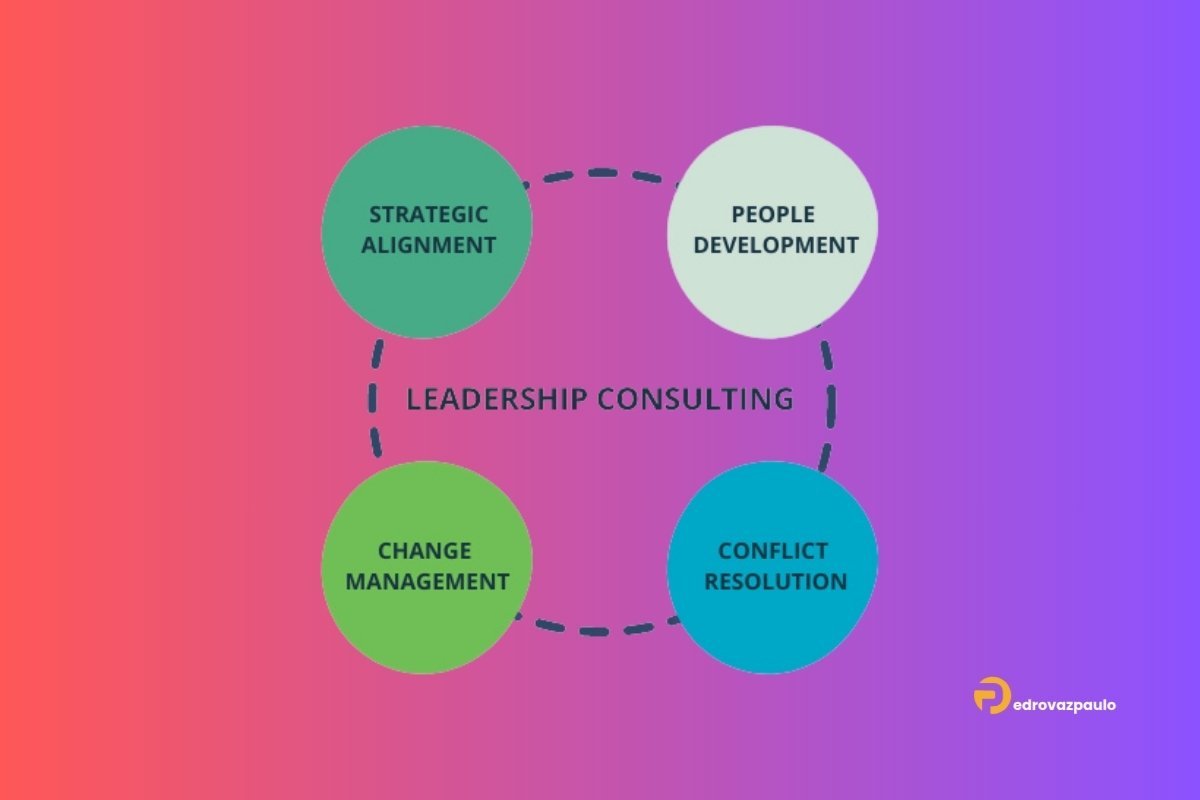
The diagram above outlines the foundational components that a corporate advisor looks at during an engagement. Look closely at how the four quadrants connect to form a complete organizational health system. We can break down each of these four specific quadrants to see how they impact a business.
Strategic Alignment
Strategic alignment ensures that every executive understands and shares the same long-term goals. Consultants frequently discover that department heads are working toward conflicting objectives without realizing it. By establishing shared metrics and clear communication paths, the advisor unifies the executive team under a single operational plan.
People Development
People development focuses on identifying high-potential workers and preparing them for future executive responsibilities. Consultants build structured mentorship paths, skill-building workshops, and behavioral training modules for middle managers. This systematic preparation reduces the skills gap when a company expands or when senior leaders retire from their positions.
Change Management
Change management involves guiding an organization through major operational shifts like corporate restructuring or technical transitions. Employees often resist major structural changes out of fear or a simple misunderstanding of the new corporate direction. Consultants design clear communication plans that ease worker anxieties and keep productivity steady during periods of transition.
Conflict Resolution
Conflict resolution addresses the interpersonal friction that can stall decision-making among senior executives. Consultants act as objective mediators, using data and behavioral science to resolve lingering professional arguments. They teach executive teams how to disagree productively, ensuring that personal disputes do not damage company performance.
You may also like to explore: gomyfinance.com saving money
Daily Responsibilities and Client Work
The daily schedule of an advisory specialist is highly varied and depends heavily on the client’s current corporate situation. On any given morning, they might conduct detailed interviews with entry-level workers to gauge company morale. In the afternoon, they might lead an intensive feedback session with the Chief Executive Officer to address specific management blind spots.
Data collection takes up a massive portion of an advisor’s regular working hours. They gather information using anonymous employee surveys, workflow observations, and historic performance evaluations. This data allows them to back up their final recommendations with clear evidence rather than vague opinions about corporate culture.
Once the data collection phase finishes, the specialist shifts their focus toward creating actionable training plans. They write customized management curriculum, design specific behavioral exercises, and establish milestones to track progress. They present these findings to stakeholders, explaining exactly how structural changes will improve the bottom line.
After presenting the strategy, the advisor stays on-site to help managers implement the new ideas. They offer real-time feedback during executive meetings and coach team leaders through difficult personnel choices. This hands-on support ensures that the corporate training translates into permanent positive habits across the company.
Tools and Frameworks Used by Leadership Consultants
To keep their assessments completely objective, these advisors rely on a variety of validated psychological and performance tools. One common method is the 360-degree feedback assessment, which gathers anonymous performance reviews from an executive’s peers, superiors, and subordinates. This comprehensive feedback gives the leader an honest view of how their management style affects the entire office.
[360-Degree Feedback Data Sources]
       │
       ├─► Peer Reviews (Colleagues)
       ├─► Direct Reports (Subordinates)
       ├─► Executive Superiors (Board Members)
       └─► Self-Evaluation (The Leader)
Another common tool is behavioral profiling, which helps managers understand their natural communication tendencies under high stress. Frameworks like the Myers-Briggs Type Indicator or the DiSC assessment help identify how different personalities interact in the workplace. Consultants use these profiles to assemble balanced project teams and minimize unnecessary interpersonal friction.
Finally, advisors use structural capability models to assess whether an organization’s hierarchy makes operational sense. They map out reporting lines, identify communication bottlenecks, and evaluate if managers have too many direct reports. These structural tools allow consultants to redesign corporate charts so work flows smoothly between departments.
How Leadership Consultants Differ from Business Coaches
It is common for people to confuse leadership consultants with traditional business coaches, but their methods are quite different. A business coach usually focuses on the individual development of a single manager, acting as a personal sounding board for daily challenges. The coach helps that single person build confidence and hit personal career milestones.
In contrast, a consultant looks at the entire organizational system and focuses on collective team outcomes. They diagnose institutional failures, rewrite corporate policies, and build training systems that affect hundreds of employees at once. While a coach asks questions to help you find your own answers, a consultant provides direct solutions based on data.
| Feature | Leadership Consultant | Business Coach |
| Primary Focus | Whole organization and executive systems | Individual professional growth |
| Main Deliverable | Data reports, structural redesigns, and policy updates | Personal guidance and skill development |
| Methodology | Objective data analysis and organizational audits | One-on-one discovery conversations |
| Project Length | Fixed-term contract focused on specific outcomes | Ongoing relationship over many months or years |
Signs Your Companxy Needs an Outside Expert
Recognizing when to bring in an outside advisory team can save an organization thousands of dollars in lost productivity. A primary indicator of trouble is a high turnover rate among talented middle managers and entry-level staff. When good workers leave in large numbers, it usually points to poor management behavior or a toxic office atmosphere.
Another major sign is a noticeable drop in speed when making critical corporate decisions. When an executive team spends months arguing over basic strategy without taking action, internal alignment has clearly failed. A consultant can step in to break the deadlock and establish a faster, cleaner path for executive approval.
Finally, companies often require help when going through rapid expansion or a sudden corporate merger. Merging two distinct corporate workforces always creates confusion regarding roles, expectations, and cultural norms. An outside expert ensures that both groups blend together smoothly without losing their core operational strengths.
Measuring Success and Return on Investment
Corporate boards want to see a clear return on investment before spending money on external management advisory services. To measure success, consultants track specific metrics before and after their training programs begin. One key indicator is employee engagement scores, which are gathered through regular, anonymous workplace surveys.
[Consulting Engagement Timeline]
Baseline Metrics ──► Behavioral Interventions ──► Post-Training Audit ──► Final ROI Review
Financially, success can be measured by looking at the reduction in recruitment costs resulting from lower employee turnover. When managers improve their behavior, staff retention rises, which means the company spends less money replacing workers. Organizations also see fewer project delays, which directly increases profit margins over time.
Operational efficiency metrics offer another excellent way to judge the value of an advisor’s work. Consultants look at how long it takes teams to launch new products or complete cross-department tasks. A successful consulting engagement always results in faster project completion times and fewer communication errors between teams.
How to Evaluate and Hire the Right Specialist
Finding the right advisor requires looking past basic marketing materials to examine a candidate’s actual track record. You should look for professionals who have extensive experience working within your specific industry sector. A consultant who understands the unique regulatory and operational pressures of your market will provide highly practical advice.
Always ask potential consultants for detailed case studies that show measurable results from their past corporate contracts. Look for evidence of how they helped previous clients solve problems similar to the ones your business faces today. Reliable professionals will gladly share references and explain their analytical methods in plain English.
Key hiring tip: Avoid advisors who offer a single, rigid training program for every client. A great leadership consultant tailors their frameworks to match your unique workplace culture and business goals.
The Long-Term Impact of Strong Management
Investing in management development creates a resilient corporate foundation that can withstand unexpected economic shifts. When leaders communicate clearly and treat teams fairly, the entire company becomes more agile and innovative. Employees feel secure in their positions, which naturally leads to higher productivity and better customer service.
Ultimately, a leadership consultant helps an organization build a self-sustaining culture of continuous professional improvement. They leave your company with the tools, data systems, and behavioral habits required to train future generations of executives. This structural stability ensures that your business stays competitive and unified long after the consultant’s contract ends.
Here are 5 frequently asked questions about leadership consultants that are popular in search queries but were not covered in the original blog post.
FAQs about Leadership Consultant
1. What is the difference between a leadership consultant and a management consultant?
While both roles aim to improve business performance, they target completely different areas of an organization. Management consultants focus on the mechanical side of a business, analyzing supply chains, financial systems, technology, and operational workflows to increase efficiency.
Leadership consultants focus entirely on the human side of the business. They work on manager behavior, team communication, and executive alignment. In short, a management consultant repairs the structural machinery of a company, while a leadership consultant trains the people who run that machinery.
2. What qualifications or credentials do you need to become a leadership consultant?
There is no single legal license required to practice, but most successful professionals have a strong academic background. They typically hold a bachelor’s or master’s degree in business administration, human resources, or organizational psychology.
Beyond a college degree, real-world corporate experience is highly critical. Most organizations will only hire advisors who have spent years working in senior management or executive roles themselves. This background gives them the necessary industry authority and peer-to-peer trust required to coach other executives.
3. How much do leadership consultants typically charge for their services?
Fees vary heavily depending on the advisor’s past track record and the scale of the client company. Independent specialists often charge an hourly rate that ranges anywhere from 150 to 500 dollars.
For larger, long-term corporate contracts, consultants rarely bill by the hour. Instead, they structure their fees as a flat project rate or a monthly retainer. These corporate agreements routinely run between 5,000 and 20,000 dollars per month depending on how many teams the advisor needs to train.
4. Can small businesses benefit from these services, or are they only for large corporations?
While large corporations hire them frequently, small businesses often see a massive return on investment from outside management advice. In a small startup, a single toxic manager can ruin the entire company culture because teams work so closely together.
A consultant helps small business founders transition from hands-on builders to true executive leaders. The advisor teaches the owner how to delegate daily duties, stop micro-managing, and establish a healthy workplace framework before the company scales up.
5. Which industries hire leadership consultants the most?
Leadership consultants operate across almost every sector, but they are highly sought after in rapid-growth fields like technology, healthcare, and finance. They are also frequently brought into manufacturing firms and large non-profit groups.
Any industry that deals with fast market shifts, constant technical updates, or high employee turnover relies heavily on these experts. The outside advice ensures their management layer remains stable during stressful operational periods.